
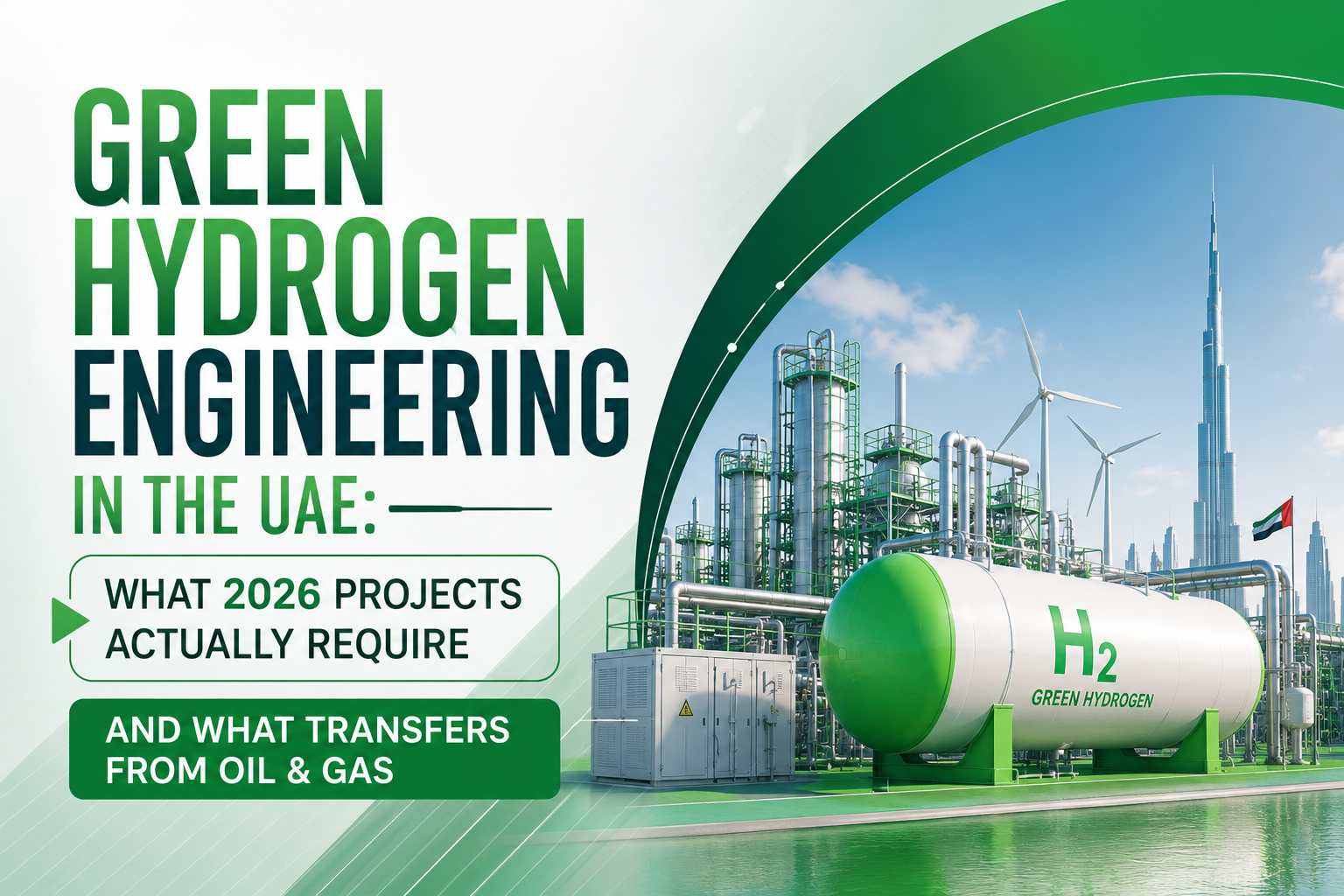
GREEN HYDROGEN ENGINEERING IN THE UAE: WHAT 2026 PROJECTS ACTUALLY REQUIRE — AND WHAT TRANSFERS FROM OIL & GAS
Green Hydrogen Engineering in UAE – A 2026 Technical Guide
Introduction
Green hydrogen is in an awkward but significant transition in the UAE. It is past the pilot stage — the Siemens/DEWA/Expo 2020 pilot in Dubai demonstrated technical feasibility at small scale. It has not yet reached the large-scale commercial project phase — though the pipeline of announced projects, including Masdar’s Abu Dhabi initiatives and NEOM’s Helios project in Saudi Arabia, indicates that commercial-scale development is approaching.
Oman, Saudi Arabia, the UAE, and Qatar have made efforts to develop their low-carbon hydrogen industries but have been constrained by higher-than-expected costs, the difficulty of transporting hydrogen over long distances, and the reluctance of potential buyers to sign long-term contracts at premium prices. Exporters Worlds
For engineering companies in Dubai, this transition point presents a specific commercial question: what technical capabilities should we be developing now to be positioned for green hydrogen project work when the volume of engineering contracts materialises?
The answer lies in understanding exactly which parts of green hydrogen engineering are genuinely new — and which are direct extensions of existing oil and gas engineering capability.
What Green Hydrogen Projects Actually Involve — Engineering Scope
A green hydrogen production facility has three primary engineering domains:
1. The Electrolyser System
The electrolyser is the technology-specific core of a green hydrogen project — and it is the area most different from conventional oil and gas engineering. Proton Exchange Membrane (PEM) electrolysers and Alkaline electrolysers (ALK) are the two dominant technologies deployed at scale.
From an engineering perspective, the electrolyser itself is a technology package supplied by the OEM (Nel Hydrogen, ThyssenKrupp Nucera, Siemens Energy, ITM Power). The engineering firm’s role is in the balance of plant — the hydrogen product conditioning (compression, drying, purification), the power supply and distribution infrastructure, the cooling water system, and the utility connections.
The key engineering disciplines for electrolyser balance of plant are: process engineering (thermodynamics, sizing, P&ID development), electrical engineering (high-power DC rectifier systems, power distribution), instrumentation and control (hydrogen process control, safety system design), and civil/structural engineering for the facility footprint.
2. Power Supply — Renewable Integration
Green hydrogen is defined by using renewable electricity for electrolysis. In the UAE, this means solar PV integration — either direct connection to a dedicated solar PV array or connection to the grid with a renewable energy power purchase agreement.
The electrical engineering scope for renewable-powered electrolysis is significant: large-scale solar PV array design, DC/AC conversion and rectification, grid connection design, battery storage integration (where grid buffering is required), and energy management system design.
3. Hydrogen Compression, Storage, and Transport
Green hydrogen leaving the electrolyser is at low pressure (typically 30–50 barg for PEM systems). Depending on the end use — pipeline injection, truck delivery as compressed gas, or ship/pipeline export as ammonia — the compression and conditioning requirements vary significantly.
For UAE projects targeting hydrogen as an industrial feedstock (for ammonia production, for refinery use), compression to pipeline pressure and transfer to a nearby industrial consumer is the most likely near-term configuration. For export-oriented projects, conversion to ammonia or liquid hydrogen represents a significantly more complex engineering scope.
What Transfers Directly from Oil & Gas Engineering
The majority of green hydrogen project engineering — outside the electrolyser technology itself — uses the same disciplines and many of the same tools as conventional oil and gas process engineering:
Process engineering tools (HYSYS, PRO/II) handle hydrogen compression train design, cooling system engineering, and utility balance calculations. P&ID development methodology is identical. HAZOP study methodology is applicable and mandatory for hydrogen facilities given the extreme flammability hazard. Procurement management for balance of plant equipment follows the same pre-qualification, RFQ, technical evaluation, and inspection coordination process as any oil and gas procurement programme.
The Hydrogen-Specific Knowledge That Must Be Added
The genuinely new technical knowledge required for green hydrogen projects centres on:
Hydrogen materials compatibility — Hydrogen embrittlement of carbon steel is a critical concern for high-pressure hydrogen systems. Materials selection for hydrogen service requires specific knowledge of ASME B31.12 (Hydrogen Piping and Pipelines) and the embrittlement thresholds for different steel grades.
Hydrogen safety and area classification — Hydrogen’s very wide flammability range (4–75% in air), low ignition energy, and invisible flame make area classification and safety system design for hydrogen facilities more demanding than conventional hydrocarbon facilities. ATEX/IECEx area classification for hydrogen environments requires specific methodology adjustments.
Electrolyser integration engineering — Understanding the OEM datasheet requirements, the utility interface specifications, and the control system integration requirements of the electrolyser package is specific knowledge that oil and gas process engineers don’t have by default.
PetroSpan’s Position
Our engineering and technical support services are developing hydrogen project engineering capability systematically — identifying where our existing oil and gas engineering competence transfers directly and investing in the hydrogen-specific knowledge that doesn’t. We are positioned to support the balance of plant engineering and procurement management scope of UAE green hydrogen projects as they move into FEED and detailed engineering phases.
As we noted in our guide to UAE energy transition, the engineering companies that win through the transition are those that invest in capability development now — not when the volume of work is already being awarded.
Contact our team to discuss green hydrogen engineering requirements, or submit project details.
→ Related: Engineering & Technical Support |Energy Transition Blog |About PetroSpan

.jpg)