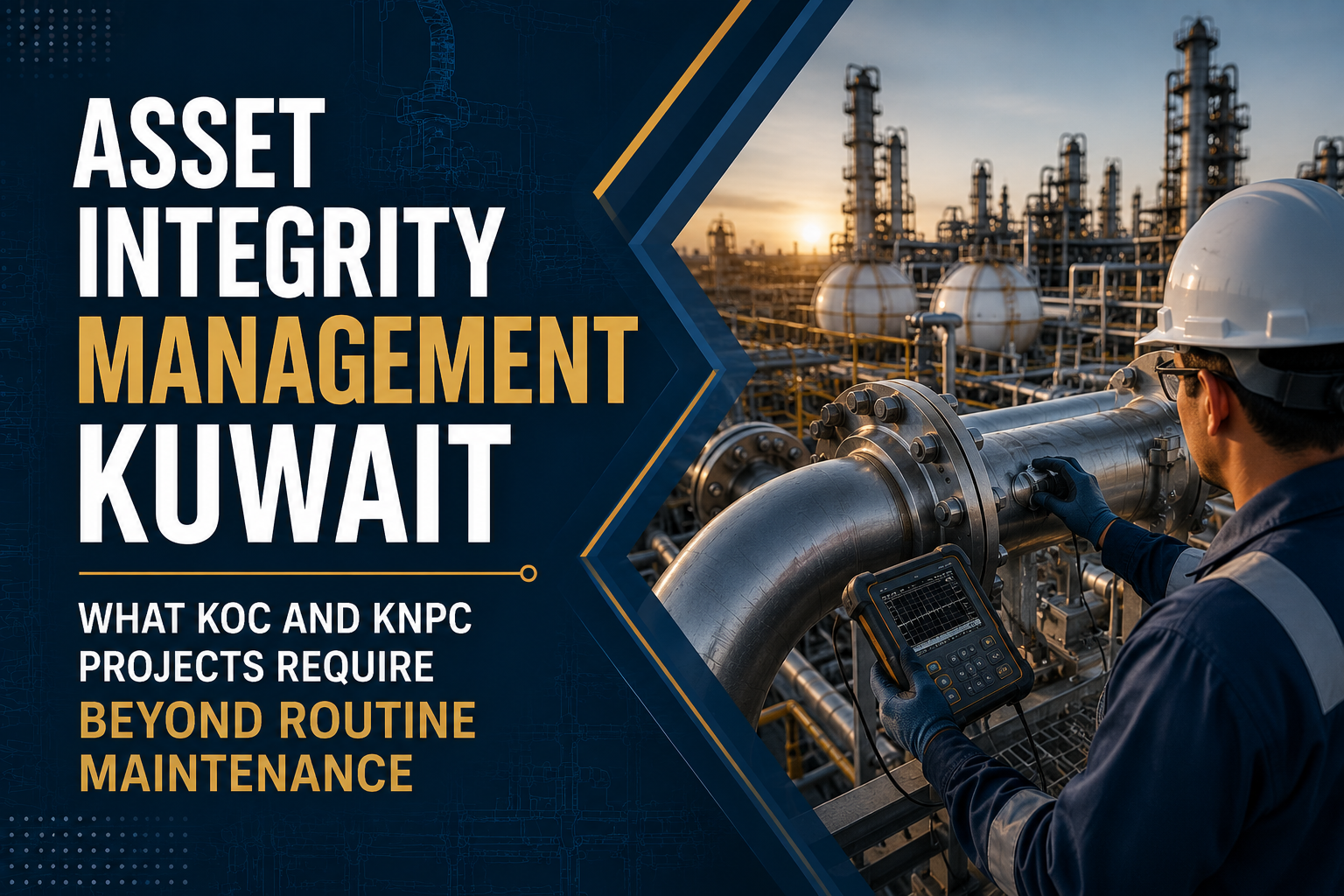
Asset Integrity Management Kuwait: What KOC And KNPC Projects Require Beyond Routine Maintenance
Asset integrity management Kuwait operators rely on covers far more ground than scheduled maintenance. Across Kuwait Oil Company’s upstream fields and Kuwait National Petroleum Company’s downstream refineries, asset integrity spans well integrity monitoring, piping and pressure vessel inspection, corrosion management, and structured risk-based inspection programmes. Therefore, this guide sets out what genuine asset integrity management capability looks like for Kuwait’s oil and gas sector, and where it goes beyond routine upkeep.
Asset Integrity Management Kuwait — Well Integrity in High-Pressure, Sour Gas Fields
KOC’s North Kuwait Jurassic Gas fields illustrate why asset integrity management in Kuwait cannot be a generic maintenance schedule. These fractured carbonate reservoirs hold gas condensate and volatile oil at pressures up to 11,500 psi, with meaningful H2S and CO2 content. Wells in this environment are managed under structured Well Integrity Management Systems that tie monitoring and testing frequency directly to the specific risk profile of each well, with compliance tracked and reported on a routine basis rather than left to periodic audit.
This risk-based approach carries through to surface piping and pressure equipment as well. Our sour gas engineering Kuwait guide covers the H2S treatment side of this same operating environment.
Asset Integrity Management Kuwait — API-Governed Inspection Across KOC and KNPC Assets
Piping and pressure vessel integrity across Kuwait’s oil and gas assets runs largely on two American Petroleum Institute codes: API 570 for in-service piping inspection, and API 510 for pressure vessel inspection. Both are treated as close to mandatory for senior inspection roles at Kuwait Oil Company, and the same expectation extends to KNPC’s refining assets. Certified inspectors under these codes manage corrosion monitoring, thickness measurement, and fitness-for-service evaluation across ageing piping and vessel systems — a meaningful discipline given that piping failures remain one of the leading causes of hydrocarbon release incidents industry-wide.
Risk-based inspection principles, formalised under API 580, are increasingly integrated directly into API 570 programmes across the region, shifting inspection effort toward the equipment and locations that carry the highest actual failure risk rather than a fixed calendar interval.
Asset Integrity Management Kuwait — Why This Matters More at KNPC’s Scale
With the Al-Zour Refinery now integrated alongside the Mina Al-Ahmadi and Mina Abdullah refineries, KNPC’s combined refining capacity has grown to roughly 1.4 million barrels a day, making it one of the largest refining operators in the region. Asset integrity programmes across a downstream network at this scale need to coordinate inspection and turnaround planning across three separate refinery sites without creating unplanned throughput loss at any one of them — a scheduling and technical challenge our refinery maintenance services Kuwait guide covers in more detail.
Asset Integrity Management Kuwait — PetroSpan’s Approach
Through our quality and compliance solutions and oil and gas sector support services, PetroSpan supports asset integrity scope across Kuwait’s upstream and downstream assets, aligning inspection planning with API 570, API 510, and KOC’s own in-house standards. This mirrors the approach set out in our asset integrity management UAE guide, adapted to Kuwait’s specific standards environment.
Contact our team to discuss asset integrity support for a Kuwait asset, or submit your project RFQ.
→ Related: Refinery Maintenance Services Kuwait | Sour Gas Engineering in Kuwait | Asset Integrity Management UAE



.jpg)