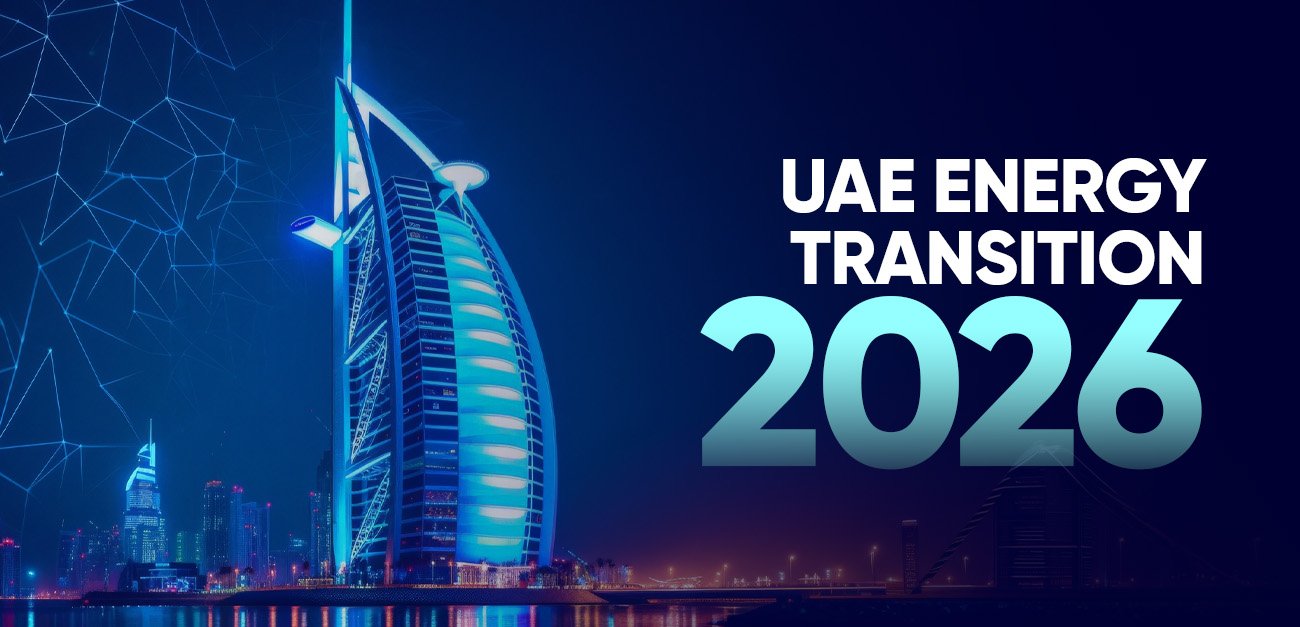
UAE ENERGY TRANSITION 2026: WHAT IT ACTUALLY MEANS FOR OIL & GAS ENGINEERING COMPANIES IN DUBAI
UAE Energy Transition in 2026 — A Practical Guide for Oil & Gas Engineering Firms
The phrase “energy transition” has become one of the most loaded — and most misunderstood — terms in the oil and gas industry’s vocabulary. For some, it signals the beginning of the end for fossil fuels. For others, it is a distant regulatory concern that doesn’t yet affect day-to-day project work. Neither of these positions is accurate in the UAE context.
The UAE’s energy transition is real, actively funded, and structurally significant. But it is not a transition away from oil and gas — it is a transition toward a dual-track energy system in which hydrocarbons and clean energy grow simultaneously, with hydrocarbons becoming progressively cleaner and more efficient.
For engineering companies, EPC contractors, and procurement specialists operating in Dubai’s energy project environment, understanding precisely how this transition shapes project pipeline, client requirements, and technical demands is commercially critical.
What the UAE’s Energy Strategy 2050 Actually Says
The UAE Energy Strategy 2050 — updated most recently in 2023 — targets a future energy mix with renewable and clean energy providing 44% of the country’s energy needs by 2050, alongside a continued and expanded role for oil and gas in the global export market.
ADNOC has separately committed to net-zero Scope 1 and Scope 2 emissions from its operations by 2045 — five years ahead of the UAE’s national net-zero target. This commitment has direct engineering consequences: it requires massive investment in carbon capture, methane reduction, electrification of oil field operations, and energy efficiency improvement across ADNOC’s asset base.
What This Means for Engineering and Procurement Work in Dubai
The energy transition creates specific project opportunities and technical requirements for engineering firms operating in Dubai:
Carbon Capture, Utilisation, and Storage (CCUS) — ADNOC has committed to capturing 10 million tonnes of CO₂ per year by 2030. Al Reyadah CCS plant in Abu Dhabi is already the world’s first commercial CCS facility in the steel industry. Engineering work for CCUS — compression, pipeline design, injection facility engineering — is a growing capital project category in the UAE that requires the same fundamental engineering disciplines as conventional oil and gas.
Electrification of Oil Field Operations — Converting gas-driven compression and pumping equipment to electric drive (often powered by grid electricity with a growing renewable share) is an active project category across ADNOC’s onshore and offshore assets. This creates engineering and procurement demand for large electric drive systems, variable frequency drives, and grid connection infrastructure.
Green Hydrogen — The UAE has positioned itself as a future green hydrogen exporter, with several projects in development. Green hydrogen facilities share many engineering characteristics with conventional process plant — compression, storage, pipeline transport, instrumentation and control — making them a natural extension for oil and gas engineering firms.
Energy Efficiency Projects — Flare reduction, heat integration, and energy efficiency improvement programmes generate a steady stream of engineering and procurement work that is explicitly driven by the transition agenda, even at facilities that remain fundamentally oil and gas operations.
What Has Not Changed — And Won’t Change Soon
Despite the transition agenda, conventional oil and gas project activity in the UAE is not declining. ADNOC’s target of 5 million barrels per day production capacity requires massive ongoing capital investment in upstream, midstream, and downstream infrastructure — the same EPC contracting, engineering services, and procurement management work that has driven Dubai’s engineering project market for decades.
ENOC’s Jebel Ali refinery expansion, Dubai Petroleum’s offshore field maintenance and integrity programmes, and the broader GCC petrochemical expansion — including Saudi Aramco’s Amiral complex and Kuwait’s Al-Zour refinery — all represent conventional oil and gas engineering work that will sustain the market through and beyond the transition period.
The Engineering Companies That Will Win
The engineering firms that thrive through the UAE’s energy transition will be those that can:
- Deliver conventional oil and gas engineering and procurement to the same high standard — because the volume of this work is not declining
- Extend their technical capability to encompass CCUS, electrification, and process efficiency projects — where the underlying engineering disciplines are closely related
- Demonstrate an understanding of energy transition requirements to clients who are increasingly evaluated on their transition credentials by financiers and international partners
PetroSpan Engineering Solutions is positioned across both dimensions — delivering conventional oil and gas engineering and procurement services in Dubai while actively developing the technical and commercial knowledge needed to support transition-related project categories.
Contact our team to discuss how your project aligns with the UAE’s evolving energy landscape.
→ Related: Oil & Gas Sector Support | Engineering & Technical Support
.jpg)