
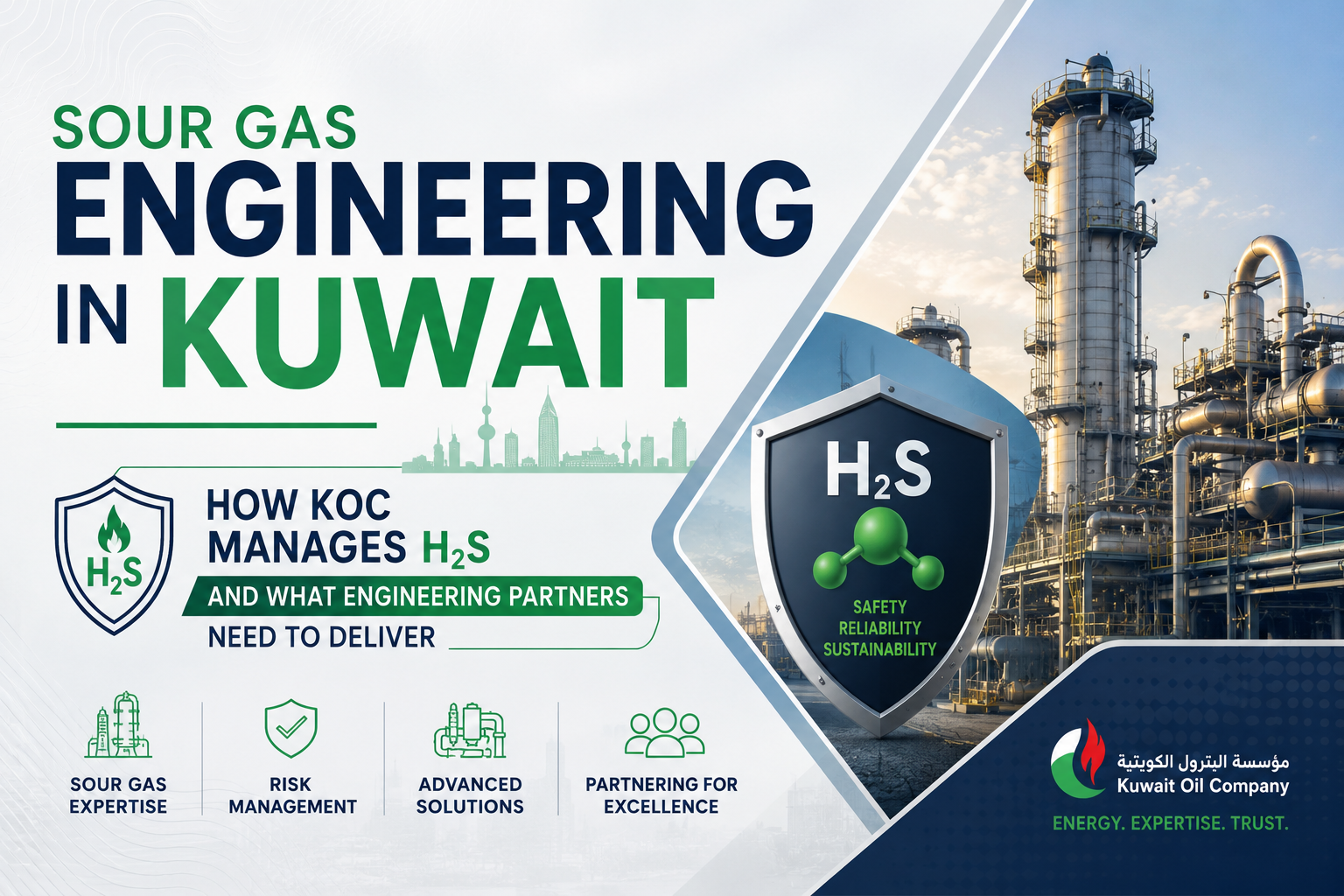
SOUR GAS ENGINEERING IN KUWAIT: HOW KOC MANAGES H2S AND WHAT ENGINEERING PARTNERS NEED TO DELIVER
Sour Gas Engineering Kuwait — H2S Treatment and KOC Gas Projects
Introduction
Sour gas engineering in Kuwait is one of the most technically demanding disciplines in the GCC upstream sector. Kuwait Oil Company’s West Kuwait (WK) concession area produces associated gas with high concentrations of hydrogen sulphide (H2S) and carbon dioxide (CO2). Moreover, these sour gas streams must be treated before entering KOC’s pipeline network for downstream processing at the Mina Ahmadi refinery. Therefore, sour gas engineering — covering gas sweetening, sulphur recovery, and sour service materials design — is a core technical requirement for KOC engineering projects.
This guide explains what sour gas engineering in Kuwait involves, how it differs from conventional gas processing, and what KOC projects require from engineering and procurement partners.
Kuwait’s Sour Gas Challenge — Why It Is Technically Significant
KOC’s West Kuwait fields produce sour gas containing up to 4% H2S and 10% CO2. These concentrations are technically significant for several reasons.
H2S is acutely toxic — concentrations above 100 ppm are immediately dangerous to life. Therefore, sour gas engineering requires HAZOP-reviewed process designs with inherently safer layouts, automatic emergency shutdown philosophy, and specific PPE and rescue requirements for operating and maintenance personnel.
Furthermore, H2S and CO2 in the presence of water create an aggressive corrosion environment. Carbonic acid (from CO2 dissolution) and sulphide stress cracking (from H2S exposure) are both active degradation mechanisms. Therefore, sour gas engineering requires careful materials selection per NACE MR0175/ISO 15156 throughout the process system.
Additionally, H2S recovery produces elemental sulphur as a by-product. Sulphur handling and storage adds a distinct engineering scope to sour gas treatment projects — one that requires specific civil, structural, and process engineering capability.
Sour Gas Engineering Kuwait — The Core Process
Amine Gas Sweetening
Amine absorption is the primary technology for sour gas sweetening in Kuwait. The sour gas contacts a lean amine solution — typically MDEA (methyldiethanolamine) or DEA (diethanolamine) — in an absorber column. The amine selectively absorbs H2S and CO2. The rich amine then passes to a regenerator, where heat strips the acid gases, regenerating the lean amine for recirculation.
Furthermore, amine system design for Kuwait applications requires specific attention to amine degradation from contaminants in the KOC gas stream. Heat stable amine salts (HSAS) and foaming tendencies are persistent operational problems that process engineers must address in the design phase — not discover during commissioning.
Sulphur Recovery Units (SRU)
H2S recovered from the amine regenerator overhead feeds the sulphur recovery unit. The Claus process converts H2S to elemental sulphur through thermal and catalytic stages. KOC’s West Kuwait gas sweetening project, awarded to Megha Engineering at USD 225 million, includes sulphur recovery units operating on a Build, Own, and Operate (BOO) basis — treating up to 120 MMSCFD of sour gas.
Therefore, engineering partners serving KOC sour gas projects need familiarity with Claus SRU design, sulphur pit and forming systems, and tail gas treatment (TGT) units that reduce residual sulphur emissions.
Sour Gas Engineering Kuwait — Materials Requirements
Sour service materials selection is non-negotiable on KOC projects. Every pressure-containing component in contact with sour gas must comply with NACE MR0175/ISO 15156. Moreover, weld procedure specifications (WPS) must be qualified for sour service — hardness limits apply not just to base metal but to heat-affected zones and weld metal.
Furthermore, for piping and equipment in H2S-wet service, hydrogen-induced cracking (HIC) testing of plate materials is typically required. Therefore, sour gas engineering procurement requires specific material certification beyond standard mill test certificates.
Sour Gas Engineering Kuwait — Procurement Challenges
Procuring equipment for sour gas service in Kuwait projects adds specific requirements:
Amine circulation pumps must be specified for amine service — API 610 category OH2 or BB1 pumps with sour service trim and mechanical seals qualified for amine fluids.
Absorber and regenerator columns are typically fabricated in carbon steel with specific PWHT (post-weld heat treatment) and NACE-compliant weld procedures. Third-party inspection during fabrication is mandatory on KOC projects.
Sulphur forming and pastillating equipment comes from a limited OEM base — Sandvik, Rotoform, and equivalent suppliers. Early procurement engagement with these OEMs is essential given 20–36 week delivery lead times.
Our engineering and technical support covers sour gas process engineering, and our procurement management handles the specialist sourcing these projects require. As discussed in our gas compression guide for Oman, gas processing procurement in the GCC requires specific OEM knowledge — Kuwait sour gas is no different.
Contact PetroSpan or submit your Kuwait project RFQ.
→ Related: Engineering & Technical Support |Gas Compression Oman



.jpg)