
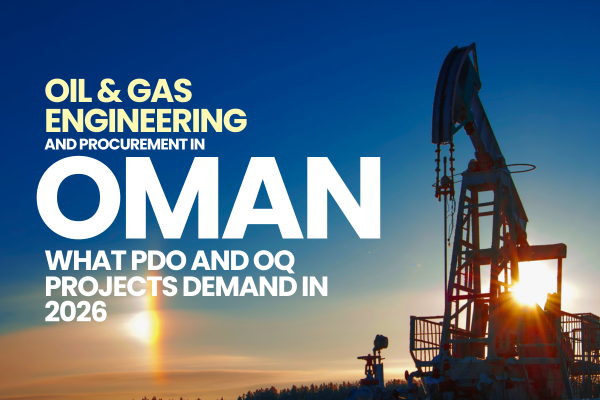
OIL & GAS ENGINEERING AND PROCUREMENT IN OMAN: WHAT PDO AND OQ PROJECTS DEMAND IN 2026
Engineering and Procurement for Oil & Gas Projects in Oman – A 2026 Guide
Introduction
Oman’s oil and gas sector is, by most measures, one of the most technically demanding and procurement-intensive in the Middle East. With Petroleum Development Oman (PDO) operating approximately 130 producing fields across 100,000 square kilometres — managing nearly 6,000 active wells — and OQ running an expanding downstream, LNG, and renewables portfolio, the scale and complexity of engineering and procurement activity in Oman is substantial.
Yet for many UAE-based engineering and procurement companies, Oman remains underserved. The focus of most Dubai-headquartered engineering firms is on Abu Dhabi and the UAE market. Oman is treated as secondary — despite being geographically close, commercially accessible, and presenting significantly lower competition for qualified engineering and procurement partners.
This guide explains what Oman’s energy sector actually demands from engineering and procurement partners — and why UAE-based firms with the right capability are well-positioned to serve it.
The Oman Oil & Gas Market — Key Facts for Engineering Suppliers
The Sultanate of Oman’s oil and gas sector is valued at approximately USD 4.5 billion and projected to reach USD 5 billion by 2030. Key characteristics for engineering and procurement partners to understand:
PDO is dominant in upstream — Petroleum Development Oman, a joint venture between the Government of Oman (60%), Shell (34%), TotalEnergies (4%), and PTTEP (2%), is responsible for approximately 70% of Oman’s total oil and gas production. PDO’s Block 6 concession covers central Oman and represents the primary upstream engineering and procurement market.
OQ is expanding downstream — OQ SAOC (formerly Oman Oil and Orpic Group) manages a growing portfolio spanning refining, petrochemicals, LNG, and renewables. The Duqm Refinery — a USD 8 billion project — and the Sohar Refinery represent major downstream engineering and procurement demand centres.
ICV mandate shapes procurement — Oman’s In-Country Value (ICV) strategy mandates that a minimum of 30% of project value on oil and gas contracts must be sourced from local suppliers. This means international engineering and procurement partners operating in Oman must either work with Omani sub-suppliers or partner with ICV-compliant local firms.
The Duqm Special Economic Zone is growing — Duqm SEZ, on Oman’s south coast, is actively developing as an industrial and refining hub. New petrochemical, LNG, and hydrogen projects in Duqm are creating significant engineering and procurement demand that will accelerate through 2026 and 2027.
What PDO Projects Specifically Require from Engineering Partners
PDO operates one of the most rigorous contractor and supplier management systems in the GCC. Characteristics of the PDO engineering and procurement environment that new entrants must understand:
PDO’s technical specifications are exacting — PDO’s engineering specifications (known as DEP standards, inherited from Shell’s global technical standards) are detailed and non-negotiable. Engineering deliverables must comply precisely with applicable DEPs. Partners unfamiliar with Shell/PDO engineering standards frequently require significant rework of first-issue deliverables.
HSSE is genuinely enforced — PDO’s “Target Zero” HSSE philosophy is not aspirational branding. Contractors with HSE incidents on PDO projects face suspension and potential blacklisting. HSE management plans, job safety analyses, and permit-to-work compliance are monitored actively.
Vendor registration is a prerequisite — Like ADNOC and ENOC, PDO maintains an approved vendor list. Engineering firms and product suppliers cannot receive PDO purchase orders without being registered and approved. The registration process requires ISO 9001:2015 certification, financial documentation, technical capability assessment, and reference project verification.
Local content matters commercially — PDO evaluates bid submissions not only on price and technical capability but on ICV commitment. Bidders who can demonstrate credible local content plans — using Omani sub-contractors, employing Omani nationals, procuring locally where feasible — consistently outperform technically equivalent bidders without this element.
What OQ Projects Require
OQ’s downstream and gas processing projects require a different engineering and procurement profile than PDO’s upstream operations:
- Process engineering capability for refinery and petrochemical systems
- Familiarity with IEC and ASME design codes applicable to downstream facilities
- Experience with LNG and gas processing procurement — compressors, heat exchangers, cryogenic equipment
- EPC contractor interface management capability
- Environmental compliance documentation aligned with Oman’s regulatory framework
How a Dubai-Based Engineering Partner Serves the Oman Market
The geographic proximity between Dubai and Muscat — approximately four hours by road or one hour by air — makes Dubai an effective base for serving Oman’s engineering and procurement market without establishing a permanent in-country presence immediately.
PetroSpan Engineering Solutions is an ISO 9001:2015 certified engineering and procurement management company headquartered in Dubai, with procurement capability and engineering technical support that directly addresses what PDO, OQ, and Oman’s growing downstream sector requires. Our team has GCC project experience, deep familiarity with Shell-derived technical standards, and a procurement network that can source to Omani project specifications.
If you are planning an engineering or procurement engagement in Oman and want to discuss how PetroSpan can support your project from Dubai, contact our team or submit your project details.
→ Related: Procurement Management | Engineering & Technical Support | About PetroSpan

.jpg)