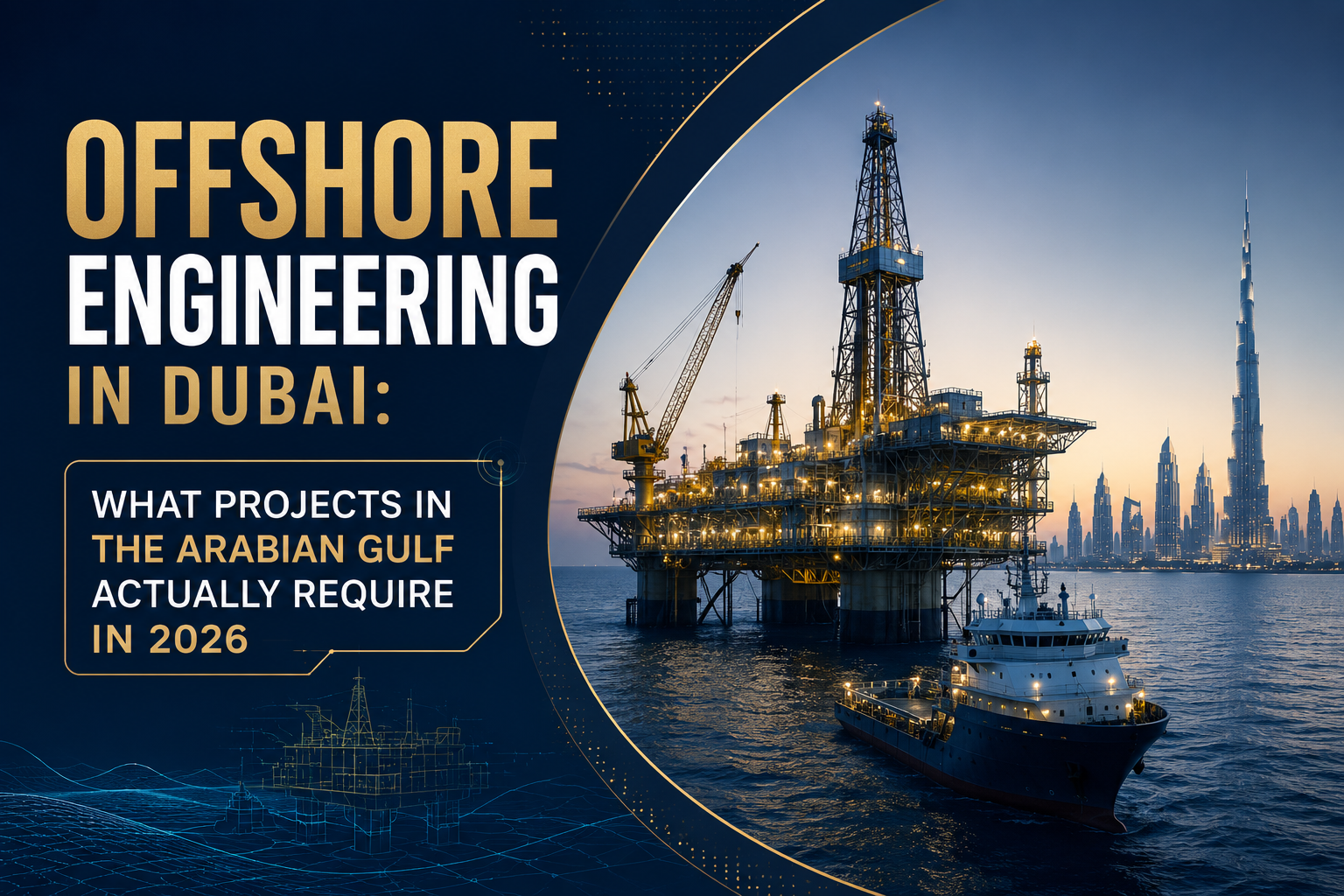
OFFSHORE ENGINEERING IN DUBAI: WHAT PROJECTS IN THE ARABIAN GULF ACTUALLY REQUIRE IN 2026
Offshore Engineering Company in Dubai — Arabian Gulf Project Requirements in 2026
Introduction
Dubai’s offshore oil and gas history is longer and more technically complex than many engineering market participants appreciate. Dubai Petroleum Establishment (DPE) has operated offshore fields in the Arabian Gulf since the discovery of the Fateh Field in 1966 — and the engineering legacy of 60 years of continuous offshore operations, combined with the present-day integrity and production optimisation challenges of ageing assets, creates a specific and sustained demand for offshore engineering capability in Dubai.
For engineering companies positioning themselves to serve Dubai’s offshore oil and gas sector, understanding the technical characteristics of the Arabian Gulf offshore environment — and the specific requirements of Dubai Petroleum’s asset base — is essential for credible market engagement.
Dubai’s Offshore Oil and Gas Assets
Dubai Petroleum’s offshore portfolio spans several producing fields in the Arabian Gulf:
Fateh Field — The original discovery, a large complex of offshore structures with production history extending back to 1969. Multiple platforms, extensive subsea pipeline networks, and ageing infrastructure that has been progressively maintained and upgraded over six decades.
Southwest Fateh — Adjacent to the main Fateh structure, with interconnected production and export infrastructure.
Rashid Field — A separate producing structure to the northwest of Fateh.
Falah and Margham — Margham is Dubai’s only significant onshore producing field; Falah is a smaller offshore structure.
The common thread across Dubai’s offshore asset base is age. The core infrastructure of DPE’s offshore facilities was installed during the 1970s and 1980s. Engineering for these assets is overwhelmingly brownfield — modifications, life extension, integrity management, and production optimisation — rather than greenfield development.
The Technical Characteristics of Arabian Gulf Offshore Engineering
The Arabian Gulf presents a specific offshore engineering environment that differs from the North Sea, Gulf of Mexico, or Southeast Asian offshore contexts that many internationally trained engineers know best:
Shallow water — The Arabian Gulf averages approximately 35 metres depth, with most DPE offshore fields in 50–80 metre water depths. This shallow water environment affects jacket structure design, installation methodology, and pipeline routing significantly compared to deeper water contexts.
High ambient temperature — Summer air temperatures consistently above 45°C and sea surface temperatures above 33°C in summer months create demanding conditions for equipment selection and materials performance. HVAC system design for offshore facilities in the Arabian Gulf requires specific engineering for these conditions.
Calcareous deposits — The Arabian Gulf’s warm, high-salinity water accelerates marine growth and calcareous deposit formation on submerged structures, affecting cathodic protection design and subsea inspection programme planning.
Seismic consideration — While the Arabian Gulf is not a primary seismic zone, offshore structural design in the UAE requires consideration of seismic loading per UAE national annexes to applicable structural codes.
Sand and dust — Aeolian sand deposition on platform decks and topsides equipment is a persistent maintenance and operability concern, affecting electrical equipment, instrumentation, and rotating machinery protection requirements.
Key Engineering Disciplines for Dubai Offshore Projects
Structural Integrity — Ageing offshore structures require regular structural integrity assessments covering fatigue life assessment, inspection data integration, and fitness-for-service evaluation of primary structural members. The approach follows API RP 2SIM (Structural Integrity Management of Fixed Offshore Structures) and the associated inspection and assessment standards.
Topsides Engineering — Brownfield modifications to DPE’s offshore production topsides — new wellhead tie-ins, separator modifications, gas lift system changes, instrumentation upgrades — are the dominant engineering work type on Dubai’s offshore assets. PetroSpan’s engineering and technical support covers the discipline range required for topsides brownfield engineering.
Pipeline and Riser Integrity — DPE’s offshore pipeline network — connecting platforms, subsea wellheads, and export terminals — requires ongoing integrity management including in-line inspection (ILI), cathodic protection monitoring, and riser inspection programmes.
Procurement for Offshore Applications — Offshore procurement has specific requirements beyond onshore projects: marine packaging and preservation requirements for equipment transported by supply vessel, offshore platform weight and footprint constraints affecting equipment selection, and hazardous area classification requirements for all equipment installed in classified zones on topsides.
PetroSpan’s procurement management services include offshore-specific procurement capability — equipment selection for offshore environmental conditions, marine packaging and logistics coordination, and offshore-rated product qualification.
Contact our team for a discussion of your offshore engineering or procurement requirements, or submit an RFQ.
→ Related: Engineering & Technical Support |Oil & Gas Sector Support |Our Projects

.jpg)