
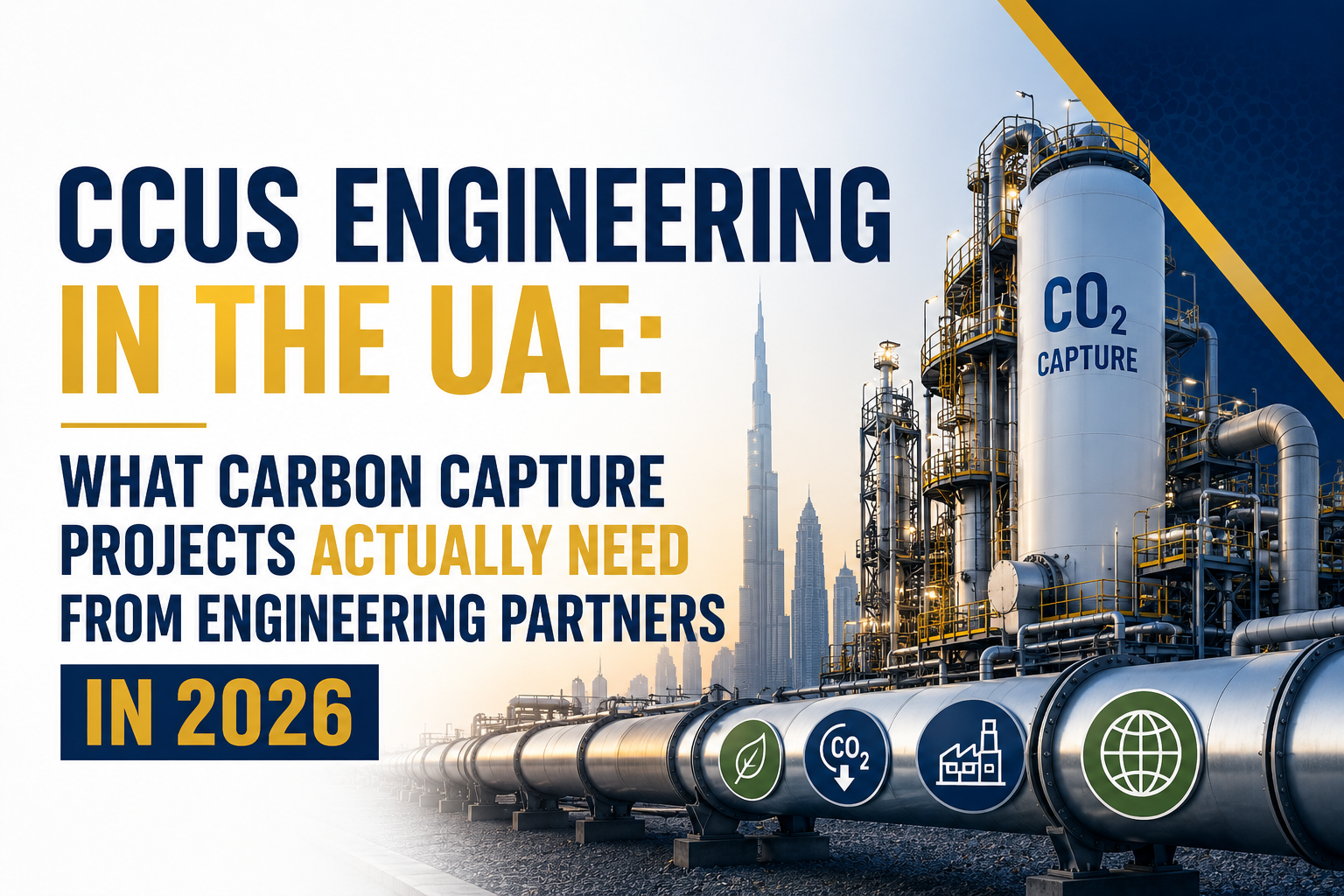
CCUS ENGINEERING IN THE UAE: WHAT CARBON CAPTURE PROJECTS ACTUALLY NEED FROM ENGINEERING PARTNERS IN 2026
CCUS Engineering Services in the UAE — A 2026 Guide for Project Teams
Introduction
Carbon capture, utilisation, and storage has made the journey from policy aspiration to active capital project faster in the UAE than almost anywhere else in the world. By 2026, the UAE hosts some of the most significant CCUS investment in the Middle East — and the engineering and procurement demands of these projects are creating a distinct and growing requirement for specialist technical capability.
The Middle East’s CCUS capacity is set to grow at a compound annual growth rate of 32% between 2026 and 2030 — a trajectory driven by UAE and Gulf NOCs who have embedded emissions management directly into core operational strategy rather than treating it as a sustainability overlay. Farmonaut®
For engineering companies, EPC contractors, and procurement specialists operating in Dubai’s energy project environment, understanding what CCUS projects specifically require — technically, commercially, and from a procurement standpoint — is increasingly essential commercial knowledge.
The UAE CCUS Landscape in 2026
The most significant UAE CCUS project currently in execution is ADNOC’s Habshan facility — a USD 615 million investment in carbon capture units, pipeline infrastructure, and CO₂ injection wells at the Habshan gas processing plant, with capacity to capture and store 1.5 million tonnes of CO₂ per year once operational in 2026.
Beyond Habshan, ADNOC’s TA’ZIZ Industrial Chemicals Zone at Ruwais — a hydrogen and ammonia hub developed with ADQ — represents a further major CCUS-adjacent capital programme. In November 2024, TA’ZIZ announced the award of EPC contracts valued at more than USD 2 billion for essential site infrastructure, with phase one expected to produce ammonia with 50% lower carbon intensity than conventional methods.
Al Reyadah — the world’s first commercial steel-based CCS facility, a joint venture between ADNOC and Masdar — remains operational, providing a reference case for CCUS integration into industrial processes beyond conventional oil and gas.
For engineering firms in Dubai, the implication is clear: CCUS is not a future project category. It is an active one with real procurement requirements now.
What CCUS Projects Need from Engineering Partners — Technically
CCUS engineering is not a fundamentally new discipline — it draws on the same core engineering capabilities as conventional oil and gas process projects. But it has specific technical requirements that engineering firms without CCUS exposure frequently underestimate:
CO₂ Compression Engineering
CO₂ behaves differently from natural gas at various pressure and temperature conditions — particularly around the supercritical state transition, which is relevant for pipeline transport and injection applications. Compression train design for CO₂ requires specific thermodynamic expertise and familiarity with materials selection for CO₂ service, including considerations for carbonic acid formation in the presence of water.
Pipeline Design for CO₂ Transport
CO₂ pipeline design follows ASME B31.4 for liquid CO₂ service and requires specific attention to ductile fracture propagation — a failure mode that is particularly relevant for high-pressure dense-phase CO₂ pipelines and that requires different fracture toughness specifications than conventional hydrocarbon pipelines. UAE-specific design considerations include the impact of high ambient temperatures on the dense-phase CO₂ envelope and the seismic loading requirements for buried pipeline design.
Injection Well Engineering
Geological CO₂ injection wells require wellhead and completion equipment rated for CO₂ service, with specific material requirements for corrosion resistance in the CO₂ + brine environment of the injection formation. Surface facility design for injection wellheads and manifolds follows the same general principles as oil and gas well engineering — but with CO₂-specific materials and monitoring requirements.
Monitoring, Verification, and Reporting (MVR)
CCUS projects require ongoing monitoring of CO₂ storage integrity — including downhole pressure and temperature monitoring, surface seismic monitoring, and atmospheric monitoring around injection sites. The instrumentation and data management systems for MVR are a specific scope element with requirements beyond conventional process instrumentation.
What CCUS Projects Need from Procurement Partners
The procurement demands of CCUS capital projects in the UAE include several categories where conventional oil and gas procurement networks require extension:
CO₂-rated pressure equipment — pressure vessels, heat exchangers, and separators rated for CO₂ service with appropriate materials of construction (typically carbon steel with specific mill test certificate requirements, or stainless steel where wet CO₂ is present)
CO₂ compressors — typically integrally geared centrifugal or reciprocating compressors from a limited number of OEMs (MAN Energy Solutions, Siemens Energy, Mitsubishi Power) — requiring early procurement engagement given 18–24 month typical delivery lead times
Valves for CO₂ service — gate, globe, check, and control valves with CO₂-specific materials and trim specifications, meeting NACE requirements for CO₂-saturated environments
Injection wellhead equipment — API 6A-rated wellhead equipment in CO₂-compatible materials
Fibre optic distributed sensing — for wellbore and pipeline integrity monitoring in CCUS applications
PetroSpan’s procurement management services and engineering and technical support cover the core engineering and procurement scope of UAE CCUS capital projects. Our ISO 9001:2015 certified processes and established global supplier network provide the foundation for effective CCUS procurement management.
The Commercial Opportunity for Engineering Firms
The focus in 2026 is on commercial viability for CCUS projects alongside increased drilling efficiency and emissions reduction through AI. Engineering firms that can demonstrate genuine CCUS technical capability — not just oil and gas process engineering capability positioned as CCUS-ready — are positioned to capture a growing share of the UAE’s most significant capital project category. AIE
The engineering disciplines that matter for CCUS — process engineering, pipeline design, instrumentation and control, rotating equipment procurement — are the same disciplines that define oil and gas engineering. The CCUS-specific knowledge layer is real but learnable. Firms investing in it now will have a material advantage as CCUS project volume grows through 2026–2030.
FAQ
No — but it requires specific knowledge extensions. CO₂ thermodynamics, ductile fracture propagation in CO₂ pipelines, and MVR system design are genuinely specific. Everything else — process design, project management, procurement management — is directly transferable from oil and gas.
For a mid-scale CCUS project (1–3 Mtpa capture capacity), FEED typically runs 12–18 months. Larger hub-scale projects require 18–24 months for FEED. Contact PetroSpan to discuss CCUS engineering and procurement requirements for your project, or submit an RFQ


.jpg)