LNG ENGINEERING IN QATAR: WHAT THE NORTH FIELD EXPANSION MEANS FOR ENGINEERING AND PROCUREMENT COMPANIES
LNG Engineering Qatar – North Field Expansion and What It Demands
Introduction
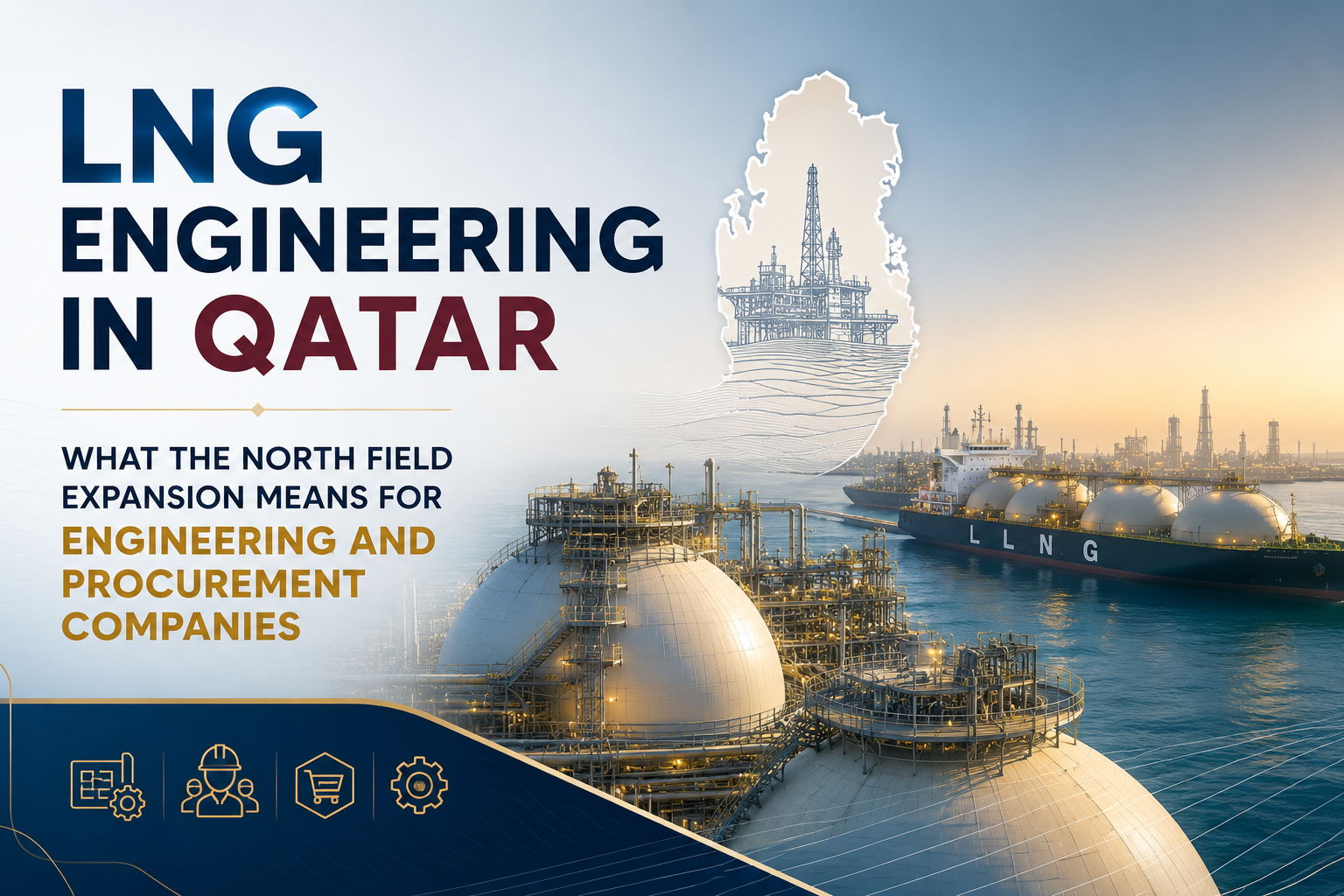
LNG engineering in Qatar is at the centre of the largest liquefied natural gas capacity expansion in history. QatarEnergy‘s North Field expansion programme — covering North Field East (NFE), North Field South (NFS), and North Field West (NFW) — will increase Qatar’s LNG export capacity from 77 million tonnes per annum to 142 Mtpa by 2031. Therefore, LNG engineering in Qatar now represents the single largest concentration of gas processing and liquefaction capital project activity in the world.
This guide explains what LNG engineering in Qatar involves, how the North Field expansion programmes are structured, and what engineering and procurement capability is required to serve Qatar’s LNG project market.
Qatar’s North Field Expansion — The Scale
The scale of Qatar’s North Field expansion is genuinely historic. North Field East (NFE) adds four LNG mega trains, each producing 8 Mtpa — 32 Mtpa in total. Furthermore, NFE incorporates carbon capture and sequestration facilities designed to cut greenhouse gas emissions by more than 25%. The NFE first train is targeting first LNG in mid-2026.
North Field South (NFS) adds a further 16 Mtpa across two mega trains, with first production targeted for 2027. Additionally, North Field West (NFW) — awarded to the Technip Energies/CCC joint venture in February 2026 — adds another 16 Mtpa across two further mega trains, targeting first cargo by 2031.
Combined, the three expansion phases add 64 Mtpa to Qatar’s existing 77 Mtpa capacity — an 83% increase. Therefore, the volume of LNG engineering activity in Qatar over the next five years has no precedent in the industry’s history.
LNG Engineering Qatar — The Core Technical Scope
Gas Processing and Liquefaction Train Engineering
Each NFE/NFS/NFW mega train processes approximately 1.5 billion standard cubic feet per day of feed gas from Qatar’s North Field. Feed gas treatment removes CO2, H2S, water, and heavy hydrocarbons before the gas enters the liquefaction loop.
Furthermore, Qatar’s LNG trains use the AP-C3MR process — a propane pre-cooled mixed refrigerant system licenced by Air Products. LNG engineering for new Qatar trains requires specific process knowledge of the AP-C3MR refrigeration cycle, refrigerant compressor systems, and cold box equipment. Therefore, process engineers targeting Qatar LNG engineering roles need familiarity with cryogenic process design — a specific extension beyond conventional gas processing engineering.
Rotating Equipment for LNG Engineering Qatar
LNG compression is the most technically demanding rotating equipment scope in Qatar projects. Each mega train includes large centrifugal compressors for the propane pre-cooling loop and mixed refrigerant compression. Baker Hughes secured a major contract in Q1 2026 for NFW compression equipment — covering six gas turbines and 12 centrifugal compressors per mega train.
Moreover, the gas turbine drivers for LNG compressors — GE Frame 7 and Frame 9 class machines — have delivery lead times of 36–48 months for new units. Therefore, LNG engineering procurement for rotating equipment must begin during FEED — well before detailed engineering is complete.
LNG Engineering Qatar — Instrumentation and Control Systems
Qatar LNG trains use advanced distributed control systems — typically Honeywell Experion or equivalent — integrated with safety instrumented systems and fire and gas detection. Furthermore, the instrument count on a single LNG mega train exceeds 15,000 individual instrument items. As a result, instrumentation engineering and procurement for LNG projects is a major scope in its own right.
Our instrumentation supply capability covers the instrument categories used in Qatar LNG projects — from pressure and temperature transmitters to safety shutdown valves and fire detection systems.
LNG Engineering Qatar — What the Supply Chain Opportunity Looks Like
The NFE/NFS/NFW prime EPC contracts are held by major international joint ventures. However, the supply chain below the prime EPC level — specialist subcontractors, equipment suppliers, technical service providers — is where UAE-based engineering and procurement companies can engage Qatar LNG project opportunities.
Furthermore, our guide to green hydrogen engineering in the UAE discussed how LNG engineering disciplines transfer directly into clean energy projects. Qatar’s LNG expansion incorporates CCS, clean ammonia, and clean hydrogen elements — making Qatar LNG experience doubly valuable for engineering professionals building transition-era credentials.
PetroSpan’s engineering and technical support and procurement management services extend to Qatar project requirements from our Dubai base.
Contact PetroSpan or submit your Qatar project RFQ.
→ Related: Engineering & Technical Support | Green Hydrogen Engineering UAE
.jpg)