
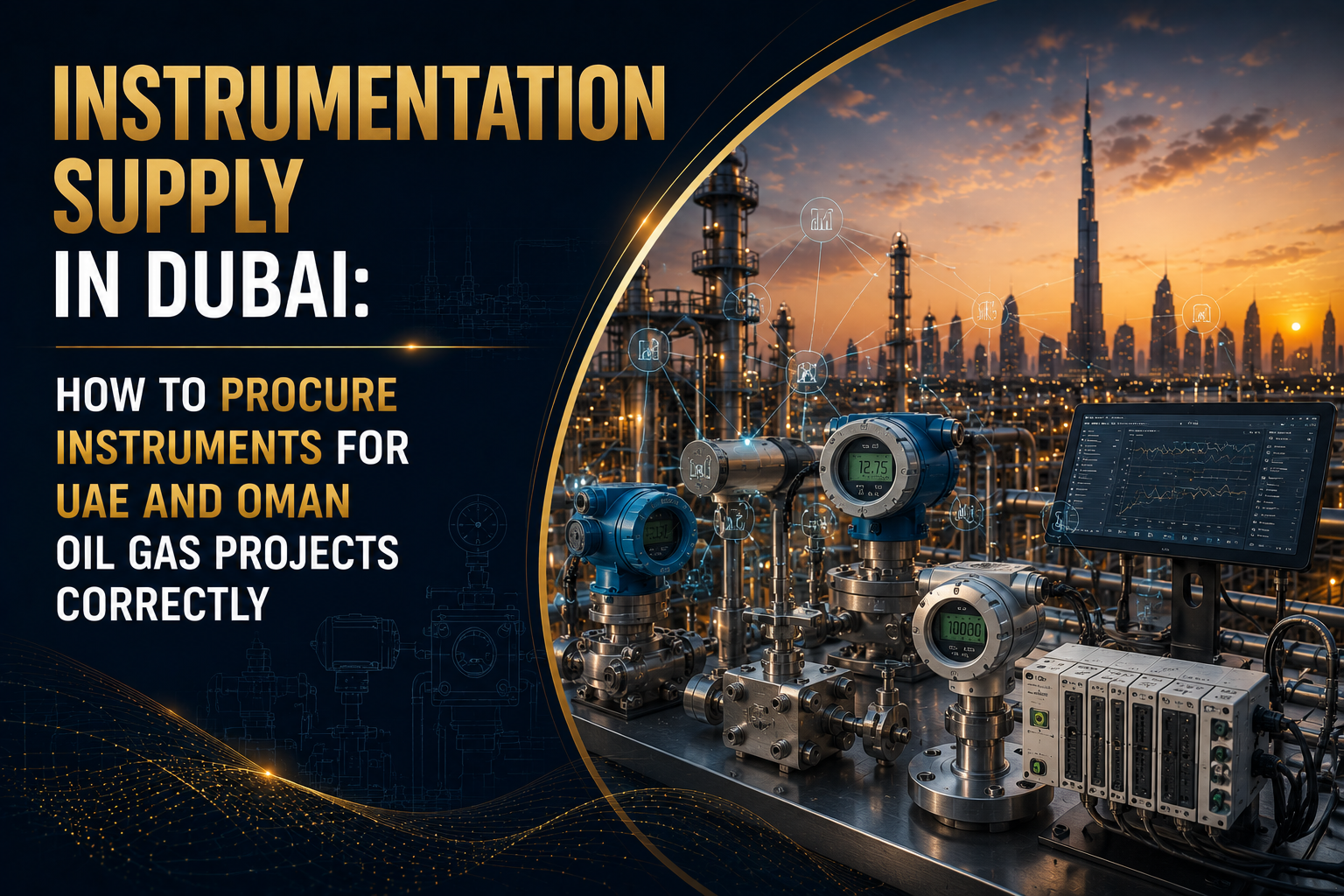
INSTRUMENTATION SUPPLY IN DUBAI: HOW TO PROCURE INSTRUMENTS FOR UAE AND OMAN OIL GAS PROJECTS CORRECTLY
Instrumentation Supply Dubai — Procurement Guide for UAE and Oman Oil Gas Projects
Introduction
Instrumentation supply in Dubai for oil gas projects is a critical procurement function — and one where errors create consequences that extend far beyond the cost of the instrument itself. Incorrect instruments, missing certifications, or wrong approval categories shut down construction activities. Therefore, understanding how to procure instruments correctly for UAE and Oman oil gas projects protects both schedule and cost.
This guide covers the key instrument categories, manufacturer approval requirements, documentation standards, and how to source instrumentation supply effectively through Dubai’s JAFZA ecosystem.
Why Instrumentation Supply Dubai Matters for Oil Gas Projects
Instruments are the sensing and measurement layer of every oil gas facility. However, they are also one of the highest-frequency procurement activities on any project — a mid-size UAE oil gas facility may have 500–2,000 individual instrument items. Furthermore, instruments sit at the intersection of process safety and operational performance. Pressure transmitters protect against overpressure. Flow meters measure custody-transfer volumes. Temperature instruments protect equipment from thermal damage.
As a result, instrumentation supply on ADNOC, ENOC, and PDO projects is subject to strict manufacturer approval requirements. Additionally, full documentation — calibration certificates, ATEX or IECEx hazardous area certification, loop calibration data — must accompany every instrument delivery. Therefore, instrumentation supply is more documentation-intensive than most other procurement categories.
Instrumentation Supply Dubai — Key Instrument Categories
Pressure Measurement Instruments
Pressure transmitters, pressure gauges, differential pressure transmitters, and pressure switches are the most frequently procured instruments on UAE oil gas projects. Furthermore, electronic pressure transmitters — Rosemount 3051, Yokogawa EJX series, Endress+Hauser Cerabar — dominate UAE and Oman project approved manufacturer lists.
For ADNOC projects, pressure transmitters must be on ADNOC’s approved instrument list. Moreover, for PDO Oman projects, approved manufacturer lists follow Shell’s global instrument vendor qualification — a different set from ADNOC’s. Therefore, procurement teams must verify approval list status per the specific operator before issuing purchase orders.
Temperature Measurement Instruments
Thermocouples, RTDs (resistance temperature detectors), temperature transmitters, and temperature gauges cover oil gas temperature measurement. Additionally, thermowell design must be validated against process flow velocity — vortex-induced vibration failure of poorly designed thermowells is a well-documented failure mode on UAE process plants. Therefore, thermowell inspection calculations must be documented for every high-velocity temperature connection.
Flow Measurement Instruments
Flow meters for oil gas service include Coriolis meters, magnetic flowmeters, differential pressure flow meters (orifice plates, Annubar), ultrasonic meters, and positive displacement meters. Furthermore, custody transfer applications — measuring oil or gas transferred between ownership boundaries — require meters with specific performance certification (typically ISO 17089 for gas, API MPMS for liquid).
However, flow meter selection for oil gas service depends strongly on the fluid characteristics — viscosity, density, solids content, gas/liquid ratio. Therefore, process engineering input is required before flow meter type selection. Moreover, this is an area where the instrumentation supply team must work directly with the process engineer — not in isolation.
Level Measurement Instruments
Level transmitters, level gauges, and float switches measure liquid levels in vessels and tanks. Guided wave radar, displacer-based level transmitters, and differential pressure level transmitters are common in UAE oil gas service. Furthermore, radar level transmitters in hazardous area service require IECEx or ATEX certification appropriate to the area classification zone.
Instrumentation Supply Dubai — Documentation Requirements
Every instrument delivery on a UAE or Oman oil gas project must include a complete documentation package. Here is what ADNOC, ENOC, and PDO typically require:
Calibration certificate — showing the instrument’s tested output versus applied input across the measurement range, issued by an accredited calibration laboratory or the manufacturer’s certified calibration facility.
ATEX/IECEx certificate — for instruments installed in classified hazardous areas. The certificate must match the area classification (Zone 0, 1, or 2) and the equipment group and temperature class.
Material traceability — for wetted parts in contact with process fluids. Material certificates showing compliance with specified material grades.
Loop calibration data — for transmitters configured for specific process ranges. The instrument tag number, engineering units, and configured range must match the instrument data sheet.
Manufacturer test report — confirming factory testing and calibration before shipment.
Additionally, for HART-communicable instruments, the HART device description file and configuration data must be included. Therefore, the documentation requirement for a modern smart transmitter is substantially more comprehensive than for conventional analogue instruments.
Sourcing Instrumentation Supply Through Dubai
Dubai’s JAFZA ecosystem contains representative offices for every major instrumentation manufacturer relevant to UAE and Oman oil gas projects — Emerson (Rosemount), Yokogawa, Endress+Hauser, Honeywell, ABB, Krohne, VEGA, and others. Furthermore, JAFZA-based distributors stock standard catalogue items for immediate delivery — reducing lead times for common pressure and temperature instruments to days rather than weeks.
However, for instruments configured to project-specific ranges and ATEX certifications, delivery lead times extend to 6–16 weeks. Therefore, early issuance of instrument requisitions — before construction start — prevents instruments becoming a critical path item.
As discussed in our valve supplier guide, the same documentation and inspection principles apply to instruments. Moreover, the same risks — accepting non-compliant instruments under schedule pressure — apply equally in both categories.
PetroSpan’s Instrumentation Supply Capability
PetroSpan’s industrial product supply covers instrumentation supply in Dubai for UAE and Oman oil gas projects — pressure, temperature, flow, and level instruments from approved manufacturers. Our procurement management process includes full documentation verification before goods release. Furthermore, our quality and compliance team reviews instrument data books against project data sheet requirements.
For Oman PDO and OQ projects, our Dubai-based supply corridor provides efficient logistics for instrument delivery to Muscat and field sites.
Submit your instrument procurement requirement or contact our team.
→ Related: Industrial Product Supply | Valve Supplier Guide | Procurement Management


.jpg)