
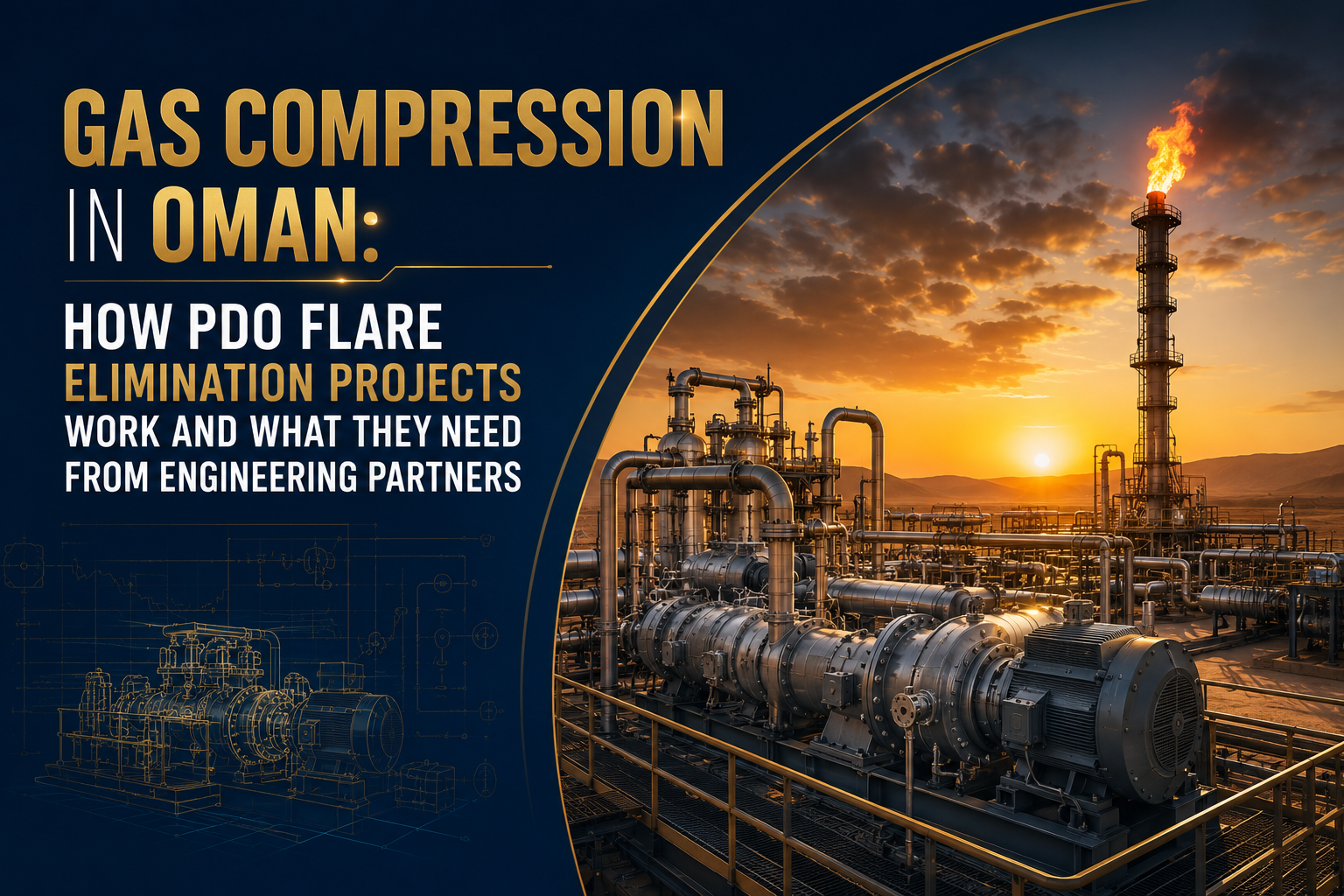
GAS COMPRESSION IN OMAN: HOW PDO FLARE ELIMINATION PROJECTS WORK AND WHAT THEY NEED FROM ENGINEERING PARTNERS
Gas Compression Oman — PDO Flare Elimination and Field Development Guide
Introduction
Gas compression in Oman drives one of the most active capital project categories in PDO’s development programme. Flare elimination, associated gas recovery, and reservoir pressure maintenance through gas injection all require compression engineering — and the volume of PDO compression project activity shows no sign of slowing in 2026.
Petrofac recently secured a direct EPC contract for PDO’s Marmul Main Production Station gas compression project. The scope included gas recovery compressors, booster compressors, gas sweetening, and dehydration units. Moreover, it included utility systems and modifications to existing facilities. Therefore, the Marmul example shows exactly what PDO compression projects demand — technically, commercially, and from a procurement standpoint.
This guide explains how gas compression projects work in Oman and what engineering and procurement partners need to deliver.
Why Gas Compression Matters in Oman’s Oil Fields
Oman’s onshore oil fields face a specific challenge. Many fields produce significant volumes of associated gas alongside crude oil. Without compression infrastructure, operators either flare this gas or vent it. Both options carry cost — either in wasted resource or in regulatory and environmental penalty.
PDO has committed to eliminating permanent flaring across its concession areas. As a result, gas compression and associated gas recovery projects are a sustained priority. Fields like Marmul, Yibal, Fahud, and the Harweel cluster all have active or planned gas compression schemes. Furthermore, reservoir pressure maintenance through gas injection — particularly in mature fields where natural drive pressure has declined — requires additional compression capacity.
Gas Compression in Oman — The Core Engineering Scope
Gas Recovery and Booster Compression
Gas recovery compressors handle low-pressure associated gas from well production headers. They compress this gas to pipeline pressure for export or further processing. Booster compressors then raise the pressure for gas injection or downstream use.
PDO’s field compression requirements typically involve reciprocating compressors for low-flow, high-pressure applications. Centrifugal compressors handle higher flow rates in gathering and injection service. Moreover, both types require inlet scrubbers, interstage cooling, and outlet aftercoolers — all of which form part of the full compression package engineering scope.
Gas Sweetening in Oman Compression Projects
Many of PDO’s producing fields contain sour gas — gas with H₂S content that requires treatment before further processing or injection. Gas sweetening using amine-based absorption removes H₂S to pipeline specification. Therefore, compression projects at fields with sour gas streams include a sweetening package as an integral scope element.
Additionally, the PDO Sakhiya field injection project handles concentrated H₂S gas at pressures up to 660 bar — among the most technically demanding compression applications in the region.
Gas Dehydration — Preventing Hydrate Formation
Dehydration removes water vapour from compressed gas. Without dehydration, water can condense in pipelines and form hydrates — solid ice-like plugs that can block pipelines and damage compressors. Therefore, every Oman gas compression project includes a dehydration package, typically using triethylene glycol (TEG) absorption.
Gas Compression Oman — Procurement Challenges
Procuring compression packages for PDO projects in Oman requires specific knowledge. Here are the main challenges:
Long lead times for major compression packages. Centrifugal and reciprocating compressor packages from OEMs — Solar Turbines, MAN Energy Solutions, Siemens Energy, Ariel, Dresser-Rand — carry delivery lead times of 36–52 weeks. Therefore, orders must be placed during FEED. Waiting until detailed engineering completion creates a critical path delay.
PDO DEP standard compliance. All equipment must comply with PDO’s Shell-derived DEP specifications. Furthermore, third-party inspection by a PDO-approved inspection body is mandatory during manufacturing. Suppliers not familiar with DEP requirements frequently submit non-compliant bids. As a result, technical bid evaluation takes longer and rework increases.
ICV requirements affect vendor selection. Oman’s In-Country Value mandate means procurement strategies must incorporate local Omani sourcing where specifications allow. However, major compression OEMs are international. Therefore, the ICV strategy typically focuses on local supply of civil materials, electrical cabling, and balance-of-plant items rather than the compression package itself.
Gas Compression Oman — PetroSpan’s Capability
PetroSpan Engineering Solutions delivers engineering and technical support and procurement management for gas compression projects across the UAE and Oman. Our team understands PDO DEP standards, Shell-derived specifications, and the compression OEM landscape. Additionally, our JAFZA-based procurement network provides fast logistics access for compression package components sourced through the UAE supply corridor.
For oil and gas sector support on Oman compression projects, our Dubai base provides the right geographic and commercial access point.
FAQ
Our Dubai base provides direct access to the JAFZA procurement ecosystem and the global compression OEM network. Furthermore, the Dubai–Muscat logistics corridor makes material delivery efficient for Oman field projects.
PDO’s approved compression OEMs typically include Solar Turbines, MAN Energy Solutions, Siemens Energy, Ariel Corporation, and GE Nuovo Pignone, among others. However, approval status requires verification per the specific DEP category.
Contact PetroSpan to discuss gas compression engineering or submit your Oman project RFQ.
→ Related: Engineering & Technical Support | Procurement Management



.jpg)