
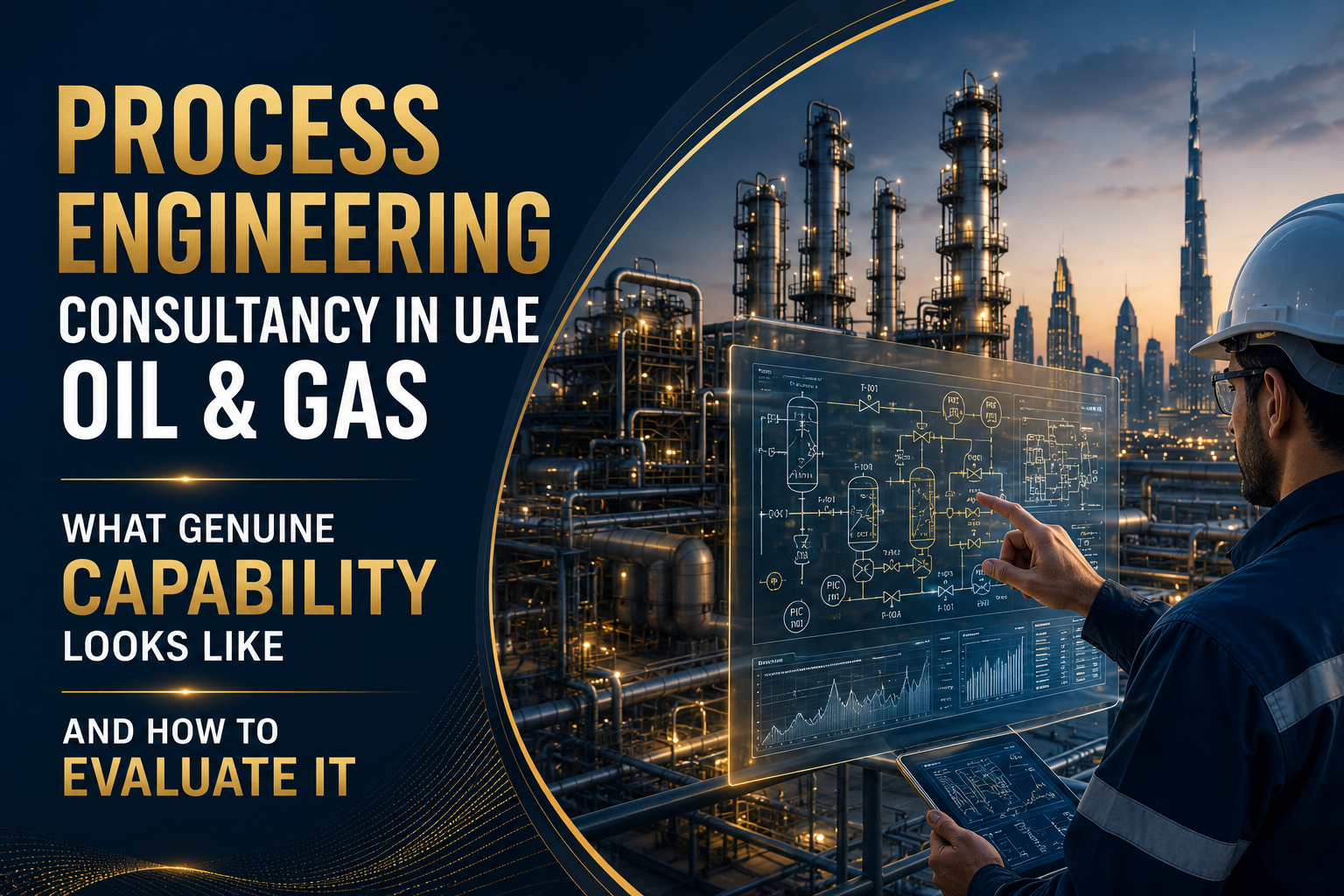
PROCESS ENGINEERING CONSULTANCY IN UAE OIL & GAS: WHAT GENUINE CAPABILITY LOOKS LIKE — AND HOW TO EVALUATE IT
Process Engineering Consultancy in UAE Oil & Gas — A Practical Evaluation Guide
Introduction
Process engineering is the technical backbone of every oil and gas project in the UAE. From the initial heat and mass balance that defines what a facility will process and how, through the Process Flow Diagrams (PFDs) and Piping and Instrumentation Diagrams (P&IDs) that define how it will operate, to the HAZOP study that identifies and resolves safety-critical risks before construction begins — process engineering establishes the technical foundation on which every other discipline depends.
In Dubai’s engineering market, “process engineering” is a capability claimed by virtually every firm. But the range of what sits behind that claim is enormous — from freshly qualified process engineers working on their second project to senior discipline leads with decades of FEED delivery experience across multiple process technologies and regulatory environments.
For project owners and EPC contractors selecting process engineering consultancy in the UAE, the ability to evaluate what actual capability exists behind the label is commercially critical.
The Core Deliverables of Process Engineering — What You Should Expect
Heat and Mass Balance (HMB) The HMB is the process engineer’s fundamental design basis — defining the flow rates, compositions, temperatures, and pressures at every point in the process for each defined operating case (normal, maximum, minimum, start-up, shutdown). An HMB developed in HYSYS, PRO/II, or equivalent simulation platform provides the quantitative foundation for equipment sizing, utility consumption estimation, and downstream discipline design.
A process engineer who cannot produce a credible HMB — or who delivers one that has not been validated against vendor data and operating philosophy — is not providing FEED-quality process engineering.
Process Flow Diagrams (PFDs) PFDs translate the HMB into a visual representation of the process — showing major equipment, process streams, key instrumentation, and operating conditions. UAE project owners and ADNOC reviewers expect PFDs developed to defined drawing standards, with process conditions annotated at each node and consistency verified against the underlying HMB simulation.
Piping and Instrumentation Diagrams (P&IDs) P&IDs are the most labour-intensive and technically consequential process engineering deliverable. They define every pipe, every valve, every instrument, every safety device, and every control loop in the facility. The P&ID is the document from which instrumentation engineers, piping engineers, and instrument & control engineers develop their discipline deliverables — errors and omissions in the P&ID propagate into every downstream discipline.
As we discussed in our FEED engineering guide, P&ID quality is the single most reliable indicator of FEED study quality.
HAZOP Facilitation and Action Management The Hazard and Operability Study (HAZOP) is a systematic examination of process P&IDs to identify how deviations from design intent could lead to hazardous or unintended consequences. For UAE oil and gas projects, HAZOP is mandatory before detailed engineering proceeds — and the quality of the HAZOP study directly affects the safety of the facility that is eventually built.
A process engineer who has facilitated HAZOP studies — not just participated — and who has managed HAZOP action tracking through to closure is demonstrating a level of process safety competency that distinguishes genuinely senior practitioners from those with only design experience.
Flare System Design Flare and pressure relief system design — using FLARENET or similar sizing tools — is a process engineering discipline that is frequently underestimated in scope during FEED budget development. The flare system must be sized for the maximum credible simultaneous relief case, accounting for blocked outlets, utility failures, and fire scenarios across the entire facility. Errors in flare system design discovered during detailed engineering require significant P&ID rework.
How to Evaluate Process Engineering Capability in Dubai
The questions that reveal genuine process engineering competency:
“Show me a HYSYS model you built for a recent FEED study. Walk me through the operating cases you considered and how you validated the simulation against vendor data.” A process engineer who has genuinely led this work can answer this specifically. One who has supported others’ work cannot.
“Describe the most significant HAZOP action you have managed from identification through engineering resolution.” The answer reveals both HAZOP methodology understanding and the ability to translate safety study findings into engineering changes.
“What is your approach to flare system sizing when the relief load is dominated by utility failure cases rather than blocked outlet cases?” This is a specific enough process engineering question that only practitioners with genuine experience give a credible answer.
PetroSpan’s Process Engineering Capability
PetroSpan’s engineering and technical support includes process engineering consultancy delivered by engineers with genuine FEED and detailed engineering track records — HMB development, PFD and P&ID authorship, HAZOP participation, and flare system engineering. Our process engineering capability is directly aligned with what UAE oil and gas capital projects require.
Contact our team to discuss process engineering requirements for your project, or submit your project details.
→ Related: Engineering & Technical Support |FEED Engineering Guide |Quality & Compliance Solutions


.jpg)