
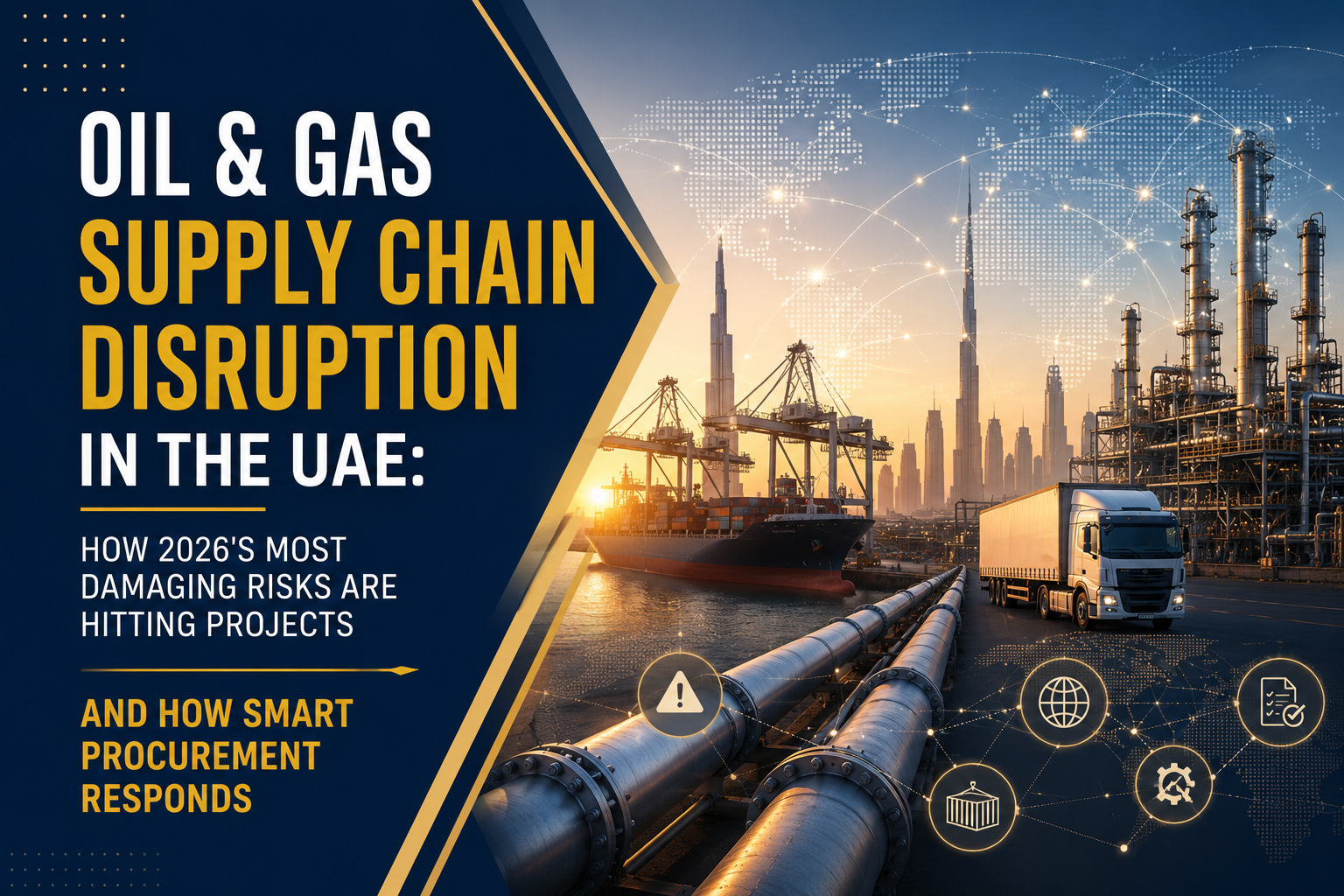
OIL & GAS SUPPLY CHAIN DISRUPTION IN THE UAE: HOW 2026’S MOST DAMAGING RISKS ARE HITTING PROJECTS — AND HOW SMART PROCUREMENT RESPONDS
Oil & Gas Supply Chain Disruption in UAE 2026 – Causes, Impact, and How Projects Are Adapting
Introduction
The global oil and gas supply chain has not operated in a stable environment since 2020. The sequence of disruptions — pandemic-era logistics collapse, post-2022 energy market volatility, Red Sea shipping disruption, and now regional geopolitical uncertainty — has fundamentally changed the risk profile of materials procurement for oil and gas projects in the UAE.
For global developers, the imperative is to mitigate conflict-driven cost and supply shocks through commodity hedging, long-term supply agreements, and locking in equipment prices early through strategic procurement to reduce vulnerability to supply-chain disruptions and price volatility.
For project procurement managers working on UAE oil and gas projects in 2026, this is not abstract strategic advice. It is the daily operational reality of managing a procurement programme in a disrupted supply environment.
The Five Biggest Supply Chain Risks for UAE Oil & Gas Projects in 2026
1. Long-Lead Equipment Lead Time Extension
The lead times for major engineered equipment — pressure vessels, heat exchangers, compressors, turbines — have extended materially from pre-2020 baselines. Items that were historically available in 16–20 weeks are now frequently quoting 30–50 weeks. For heavy equipment from European manufacturers specifically — Germany and Italy being the dominant source for high-specification refinery and gas processing equipment — logistics delays add further weeks beyond the manufacturing lead time.
The practical consequence: procurement strategy for UAE projects can no longer treat detailed engineering completion as the trigger for major equipment orders. Long-lead items must be identified and purchase orders placed during FEED — or in parallel with early detailed engineering — to avoid having engineering complete and construction ready while the critical equipment is still being manufactured.
2. Material Cost Inflation
The focus in 2026 includes commercial viability amid material inflation as a primary project delivery challenge. Carbon steel prices — driven by global steel market volatility, freight cost increases, and raw material price fluctuation — have increased substantially. For UAE projects with significant piping, structural steel, and pressure vessel requirements, unbudgeted material cost increases are a persistent programme risk. AIE
Alloy and speciality material costs have been even more volatile. CRA (corrosion resistant alloy) material — used in sour service piping, instrumentation connections, and offshore structural applications — has experienced significant price volatility linked to nickel and chromium market movements.
3. Shipping Route Disruption
Shipowners have been avoiding disrupted maritime routes, making it more difficult to secure vessels and prompting buyers across Asia, India and the Middle East to pause new procurement. For UAE projects sourcing materials from European and Asian manufacturers, alternative routing — around the Cape of Good Hope rather than through shorter but disrupted routes — adds both time and cost to the logistics chain. Oil & Gas Middle East
The practical implication is that shipment arrival dates are less predictable than in pre-disruption environments. Projects that planned construction schedules against committed delivery dates are experiencing delays when actual arrivals slip by 2–4 weeks compared to original estimates.
4. Single-Source Supplier Risk
For highly specified engineered items — particular instrument models, specific valve designs, proprietary control system components — single-source supply situations (where only one approved manufacturer can supply the specified item) create acute supply chain vulnerability. If the single-source manufacturer has a production delay, quality issue, or logistics disruption, there is no alternative source.
Effective procurement management identifies single-source risk items early in the procurement cycle and either pursues alternate qualification, adjusts specifications to allow second sources, or places orders with extended lead time buffers.
5. Quality Documentation Gaps Under Pressure
Supply chain pressure creates incentives for suppliers to cut corners on quality documentation. In a market where delivery timelines are extended and project teams are under schedule pressure, the temptation to accept materials with incomplete mill test certificates, missing inspection records, or unverified material traceability is real — and the consequences, when a UAE operator’s quality team rejects materials at the project site, are severe.
Procurement processes that maintain documentation discipline regardless of schedule pressure are not bureaucratic — they are project risk management.
How Smart UAE Projects Are Adapting
The projects that are consistently delivering on schedule and within budget in 2026’s supply chain environment are doing several things differently:
Starting procurement earlier — Long-lead items identified during FEED, purchase orders placed before detailed engineering is complete. The engineering team and procurement team running in parallel, not in sequence.
Diversifying the approved vendor list — Actively qualifying second and third sources for critical material categories to eliminate single-source risk. Accepting the upfront qualification cost as project risk insurance.
Using JAFZA as a supply chain buffer — Jebel Ali Free Zone’s warehousing and consolidation infrastructure allows UAE projects to receive and store materials earlier than site readiness allows, de-risking the site delivery schedule from shipping disruption.
Engaging specialist procurement partners — PetroSpan’s procurement management services bring a pre-qualified global supplier network, established vendor relationships, and procurement process discipline that protects UAE projects from the most damaging supply chain exposure points.
Contact our team to discuss supply chain risk management for your project, or submit your procurement requirements.
→ Related: Procurement Management |Industrial Product Supply |Engineering & Technical Support

.jpg)